From Awareness to Operations: Strengthening Cyber Resilience for SMEs Across Europe
SOC4SME contributing to cross-project collaboration and operational synergies among EU cybersecurity initiatives
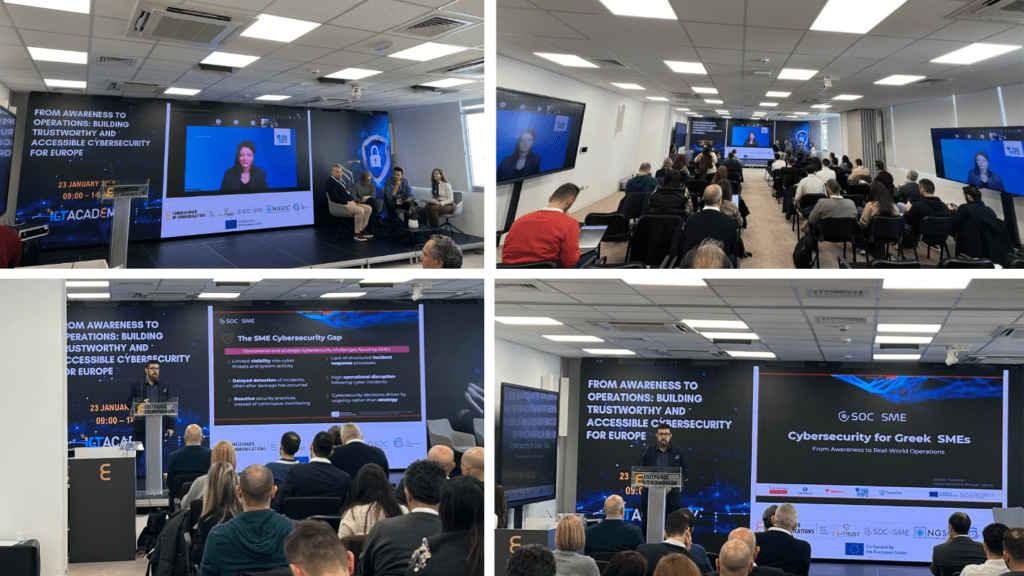
On Friday, 23 January 2026, the SOC4SME project participated in the joint cybersecurity workshop “From Awareness to Operations: Building Trustworthy and Accessible Cybersecurity for Europe”, held at DSA Academy in Cyprus.
The hands-on workshop, organised by CY-TRUST in collaboration with NG-SOC EU, SecAwarenessTruss, and SOC4SME, brought together complementary EU-funded initiatives addressing cybersecurity across the full spectrum — from awareness and trust to practical Security Operations Centre (SOC) operations and accessibility for SMEs. Through hands-on insights, tools, and real-world use cases, the event focused on transforming SOCs into practical, day-to-day cybersecurity operations, demonstrating how collaborative SOC models can deliver scalable and accessible cyber resilience for SMEs and resource-constrained organisations across Europe.
SOC4SME Contribution: From Operational Services to Policy and Governance
The SOC4SME project, which focuses on delivering operational, scalable, and accessible cybersecurity services for Greek SMEs, was represented at the workshop by two consortium partners. The project was presented by Dimitris Tsaktsiras, Sales Engineering Manager at Obrela, while the project’s policy and resilience perspective was further reinforced through panel participation by Evgenia Tsaprali, Head of Business Continuity at the National Cybersecurity Authority of Greece.
In his presentation, Dimitris Tsaktsiras explained why initiatives such as SOC4SME are critical for Greek SMEs, which face increasing cyber threats while often lacking dedicated cybersecurity expertise, financial resources, and structured processes. Many SMEs continue to operate without continuous monitoring, clear incident response procedures, or alignment with emerging regulatory requirements such as NIS2, leaving them exposed to prolonged disruptions and operational risk. Against this backdrop, SOC4SME was presented as a practical response to these challenges, offering 24/7 Managed Detection & Response (MDR) as a real, day-to-day operational service rather than a pilot or simulation. By combining AI-powered analytics with human expertise, professional incident response, and a structured onboarding model, the project enables SMEs to experience continuous threat monitoring, faster detection and response, and informed decision-making without immediate investment pressure. As he highlighted during the presentation,
“SOC4SME allows SMEs to experience cybersecurity as an operational capability rather than a one-off intervention. By supporting organisations through real incidents and continuous monitoring, the project helps them understand their actual risk profile and make informed decisions on how to sustain and evolve their cybersecurity operations beyond the project period.”
The strategic and governance dimension of SOC operations was addressed during the panel discussion by Evgenia Tsaprali, Head of Business Continuity at the National Cybersecurity Authority of Greece. Her intervention focused on the need for modern and sustainable Security Operations Centres (SOCs) to be NIS2-ready by design, serving as a practical means of implementing the Directive and strengthening organisational cybersecurity maturity. Focusing on SMEs, which represent the vast majority of enterprises in both Greece and Europe, she highlighted that many organisations continue to face structural gaps in expertise, resources, and processes. Within this context, she identified customisation as the key principle for viable SOC adoption, underlining that SOC solutions must be tailored to the needs, capabilities, and culture of each organisation. While advanced technologies such as AI and machine learning play an important role, she stressed that human-centred, supportive services remain essential in helping organisations understand, respond to, and recover from cyber incidents in real time, particularly in less mature environments.
Regarding the long-term impact of current cybersecurity initiatives, she noted that success must be assessed through clear and measurable indicators:
“When we reassess national and cross-border cyber resilience in two years’ time, the real impact of today’s initiatives should be reflected in measurable outcomes. A clear reduction in the time needed to detect, respond to, and recover from major cyber incidents will demonstrate effectiveness, alongside increased information sharing at both national and cross-border level. Ultimately, cyber resilience will be judged by the ability of organisations to withstand serious incidents, maintain their critical operations, and recover quickly without significant operational or reputational consequences.”
From EU Projects to Sustainable Impact
The event concluded with a shared understanding that cyber resilience is not built through isolated tools alone, but through a combination of operational readiness, effective governance, information sharing, and human-centred support. In this context, initiatives such as SOC4SME illustrate how EU-funded projects can move beyond awareness-raising and pilots, translating research and collaboration into tangible, day-to-day cybersecurity operations that SMEs can realistically adopt, operate, and sustain over time.
About SOC4SME
The SOC4SME project is implemented by a European consortium of public authorities and specialised cybersecurity companies, including the National Cybersecurity Authority of Greece, Obrela, Sphynx, CyberSafe, and Karavias Underwriting Agency, with co-funding from the European Union. The project supports 120 Greek SMEs by providing free cybersecurity services for 12 months through a dedicated Security Operations Centre (SOC) tailored to SME needs.