Press Release
Athens,6 November 2025
Cybersecurity is not a luxury – it is a prerequisite for the sustainability of Greek SMEs
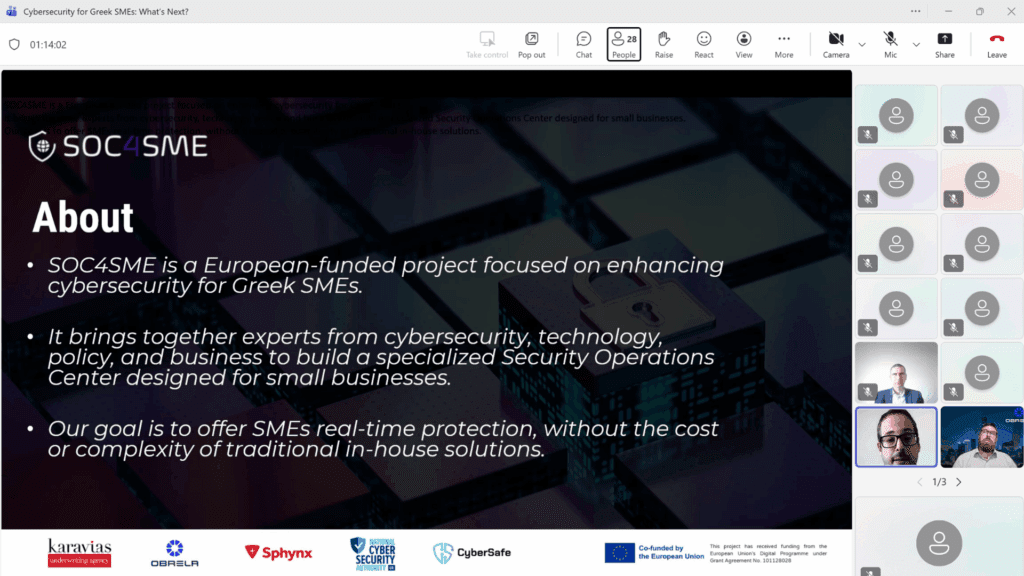
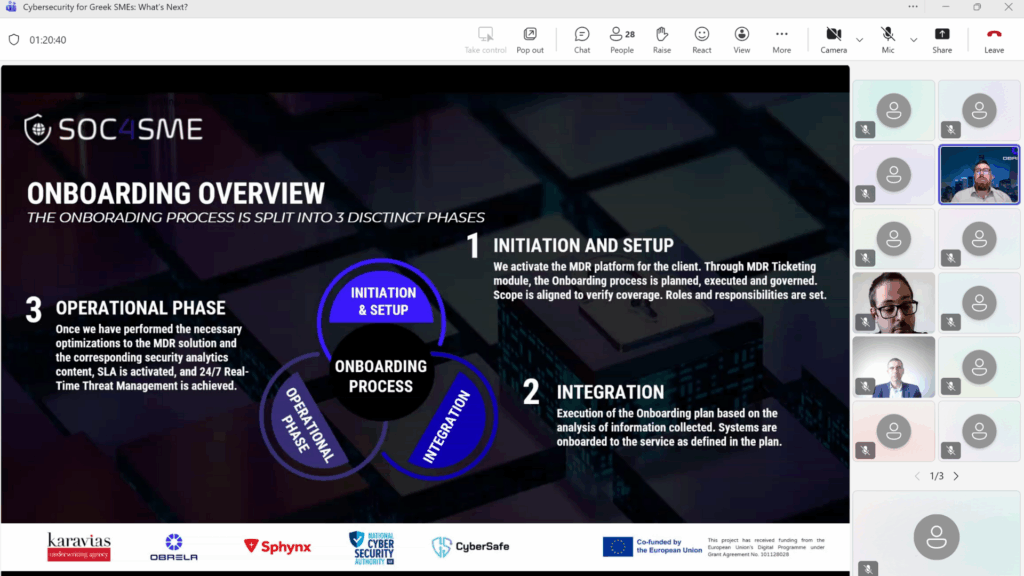
The webinar “Cybersecurity for Greek SMEs: What’s Next?” organised under the SOC4SME project shed light on the knowledge gaps, the growing threats, and the practical solutions offered by this EU-funded initiative, which provides free cybersecurity services to 120 small and medium-sized enterprises across Greece.
Held on 30 October 2025, the event brought together members of the SOC4SME consortium, who discussed the key challenges hindering the effective implementation of cybersecurity programmes among Greek SMEs. Speakers focused on the lack of awareness and training, the underestimation of digital risks, and the need to foster a lasting culture of cybersecurity within organisations.
The webinar featured representatives from the project consortium, which brings together public authorities and private organisations with strong expertise in cybersecurity, including the National Cybersecurity Authority of Greece, Sphynx, Obrela, Karavias Underwriting Agency, and CyberSafe. The discussion was moderated by Stergios Asteriou, Special Risks Manager at Karavias Underwriting Agency.
Opening the session, Mr. Thomas Dompridis, General Director of Operational Planning at the National Cybersecurity Authority of Greece, noted that “cyberattacks in Greece are rarely targeted against specific organisations; rather, they occur when vulnerabilities are detected within information systems.” He emphasised that “attackers do not discriminate – they exploit weaknesses regardless of a company’s size or financial capacity,” urging SMEs to adopt simple, cost-effective security measures.
Referring to SOC4SME, he highlighted that “SMEs often lack the capacity to develop in-house cybersecurity functions due to high costs and limited expertise. That is why they should focus on their core business and rely on trusted partners offering comprehensive solutions – such as SOC4SME.”
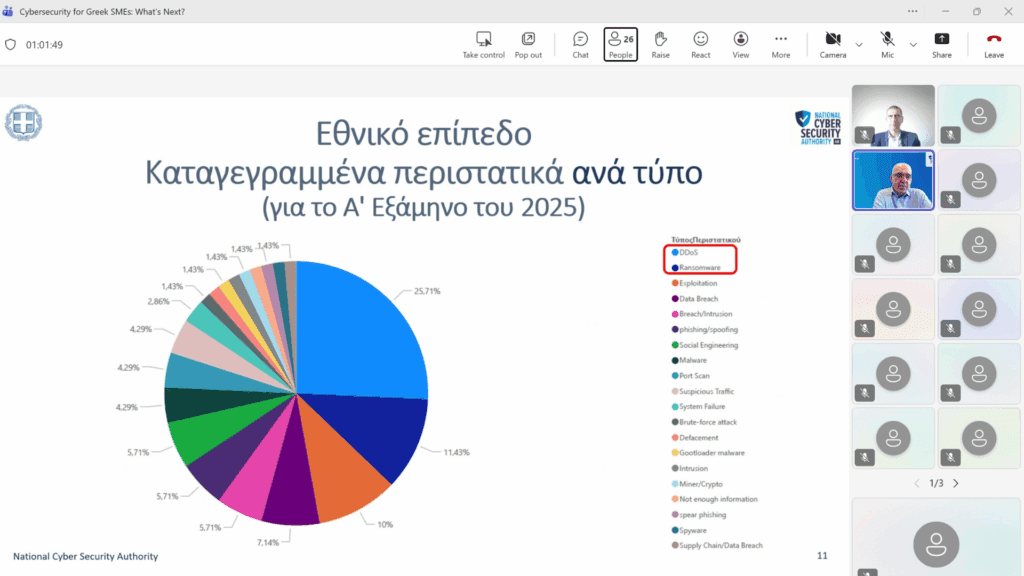
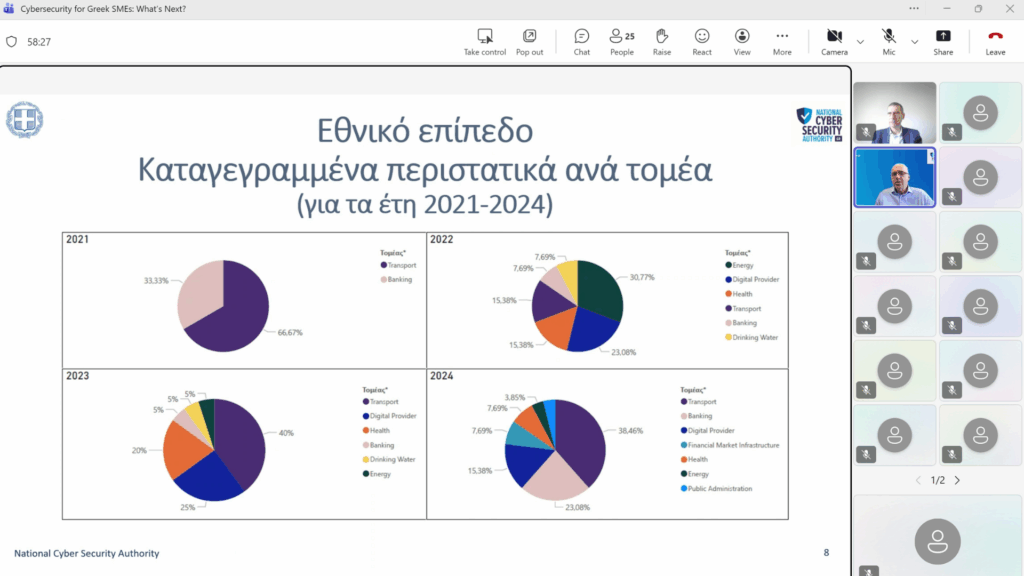
According to data presented by the National Cybersecurity Authority, cyber incidents in Greece have increased and diversified between 2021 and 2024, targeting primarily the transport, banking, energy, health, and public administration sectors. The transport sector remained the most affected (40% of incidents in 2023 and 38.46% in 2024), followed by digital service providers and banks. For the first half of 2025, the public administration (27.14%), digital providers (12.86%), and health sector (11.43%) were the main targets, with DDoS and ransomware attacks causing the most significant damage.
Mr. Dimitris Koupatsiaris, Project Manager at CyberSafe, underlined that cybersecurity is no longer a purely technical issue but a strategic business enabler. As he stated, “cybersecurity has become a strategic pillar that strengthens a company’s reputation, trust, and long-term value. Investing in prevention reduces costs and enhances resilience, while building a security culture is everyone’s responsibility – starting from leadership.” He added that “many businesses operate under a false sense of security, believing that cyberattacks happen only to others – when in reality, it is a matter of time, not probability.”
Mr. Manos Iatrelis, Chief Marketing & Communication Officer at Sphynx, presented the “SOC-as-a-Service” model adopted by SOC4SME, which delivers managed detection and response services without the cost and complexity of a traditional in-house SOC. “This model allows SMEs to focus on growth and innovation, while trusted experts monitor and respond to threats in real time,” he noted. The platform leverages AI and machine learning to identify abnormal activity and prevent incidents before they escalate. “Predictive and preventive threat intelligence has become essential for SME security,” he added.
Mr. Dimitris Tsaktsiras, Sales Engineering Manager at Obrela, emphasised that within SOC4SME, “we put business needs at the centre – cybersecurity is not a luxury, but a prerequisite for competitiveness and sustainability.” He explained that the project’s approach is based on simplicity, continuous monitoring, and real-time incident response by specialised professionals, with a strong focus on data protection. He pointed out that many SMEs remain vulnerable due to outdated systems, weak passwords, lack of staff training, and absence of formal security policies. Participation in SOC4SME, he said, offers ease of deployment, expert support, and real protection against modern cyber threats.
Together with Mr. Alexios Lekidis, R&D Director at Sphynx, they presented the range of cybersecurity services available to participating SMEs for a 12-month period, including 24/7 system monitoring and threat detection, predictive and preventive analysis powered by AI and human expertise, rapid incident response and recovery, as well as staff training, ongoing technical support, and compliance with the NIS2 Directive to strengthen operational readiness.
The call for participation in the SOC4SME programme remains open to all Greek SMEs, with a limited number of places available.
Apply now: https://soc4sme.eu/stakeholder-network/
Contact: grsmesoc@gkaravias.gr