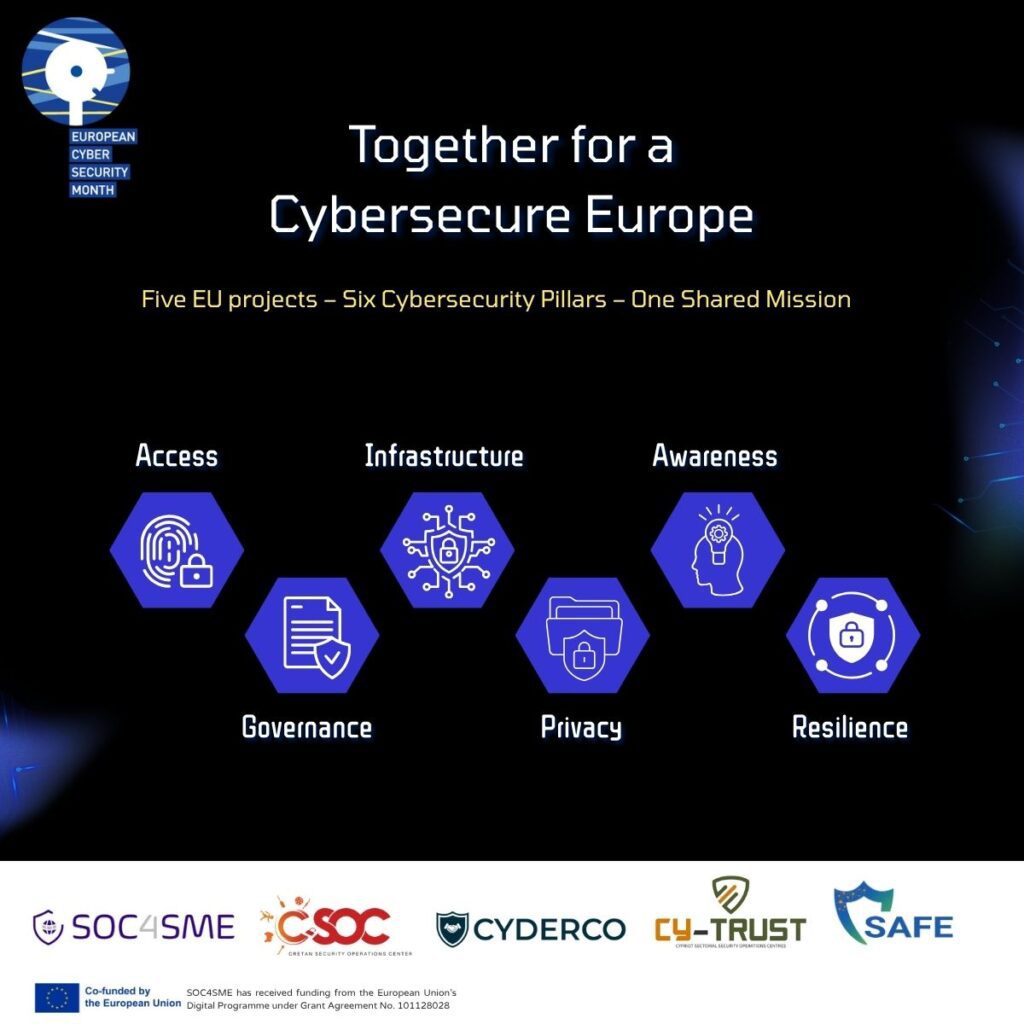
In October 2025, five EU-funded cybersecurity projects — SOC4SME, C-SOC, CYDERCO, CY-TRUST and SAFE — came together under a shared mission: to strengthen Europe’s digital resilience through coordinated communication and practical guidance.
Building on the theme “Together for a Cybersecure Europe – Five EU projects, Six Cybersecurity Pillars, One Shared Mission,” the campaign brought a unified voice to European Cybersecurity Month (ECSM), highlighting essential principles that every organization should understand and adopt.
Access
Secure identity control is the foundation of strong cybersecurity. Access management defines who can enter, view, or modify systems and data — and ensures they only receive the permissions they truly need. Weak passwords, shared credentials, or excessive privileges are common causes of security incidents and data breaches, often leading to operational disruption, financial loss, and reputational harm.
Strengthening access begins with multi-factor authentication (MFA), regular reviews of user roles, and revoking unnecessary access as soon as responsibilities change. Applying least-privilege policies reduces exposure and helps organizations maintain trust, accountability, and business continuity.
Governance
Cybersecurity governance in the EU is a structured, multi-layered system built on cooperation rather than centralization. Member States oversee their national cybersecurity, while EU-level bodies coordinate expertise, response, and policy.
Authorities such as National Competent Authorities and CSIRTs manage supervision and incident response at national level. Organisations like ENISA, the Cooperation Group, and EU-CyCLONe enable cross-border knowledge exchange and crisis coordination.
At the policy level, EU institutions create and update legislation, while dedicated bodies support innovation, resilience, and data protection. Effective governance depends on clear roles, accountability, and structured collaboration, turning EU legislation into real-world security.
Infrastructure
Cybersecurity infrastructure — networks, devices, cloud environments, and supply chains — forms the technical backbone of organizational security. When infrastructure protections function well, they are often invisible, yet they are essential for compliance and operational resilience.
Key practices include maintaining accurate asset inventories, streaming telemetry to SOCs, retaining logs, and monitoring endpoints and identities. Risk-based patching across operating systems, applications, and firmware reduces exposure, while segmentation, encryption, MFA, and secure backups strengthen protection.
Cloud services must be governed throughout their lifecycle, and suppliers should be continuously assessed based on risk. Measuring performance through indicators such as detection quality, patch times, and configuration drift ensures both security and audit-ready compliance.
Privacy
Privacy focuses on protecting personal and sensitive information from unauthorized access, misuse, or disclosure. It requires organizations to manage data responsibly, transparently, and in alignment with individuals’ rights.
For SMEs, privacy is both a regulatory requirement (e.g., GDPR) and a trust imperative. A single data breach can result in significant financial damage, legal exposure, and loss of customer confidence. Strong privacy practices enhance loyalty, resilience, and credibility.
Practical steps include data minimization, encryption, strict access controls, employee training, and regular reviews of how data is collected and stored. Effective privacy practices demonstrate respect for users and strengthen long-term digital trust.
Awareness
Awareness empowers people to become an organization’s strongest security asset. Many breaches stem from human vulnerabilities such as phishing, weak passwords, or unsafe browsing — behaviours that technology alone cannot fully prevent.
Cybersecurity awareness requires ongoing training, phishing simulations, and modelling good cyber hygiene practices. Leadership plays a critical role in fostering a culture where security is communicated openly and reinforced consistently. A strong awareness programme helps turn employees into a resilient “human firewall,” reducing risk and improving organizational readiness.
Resilience
Cyber resilience is the ability to prepare for, respond to, and recover from cyber incidents while keeping essential operations functioning.
In a landscape of increasing threats — ransomware, supply-chain attacks, service disruptions — resilience ensures minimal downtime and rapid restoration of critical services.
Effective resilience includes continuous monitoring, tested incident response procedures, reliable backup strategies, business continuity planning, and lessons learned from past incidents.
It is strengthened by workforce readiness: every employee understanding their role during an incident. Resilience is not only about surviving attacks — it is about bouncing back quickly and maintaining trust.
A Shared Commitment to a Safer Digital Europe
This joint campaign demonstrated how collaboration amplifies impact.
By combining expertise and communicating with one voice, the projects offered clear, practical guidance on the six pillars that underpin cybersecurity maturity.
The campaign reaffirmed that Europe’s digital security is strongest when built on cooperation, shared knowledge, and common purpose — principles at the heart of European Cybersecurity Month.